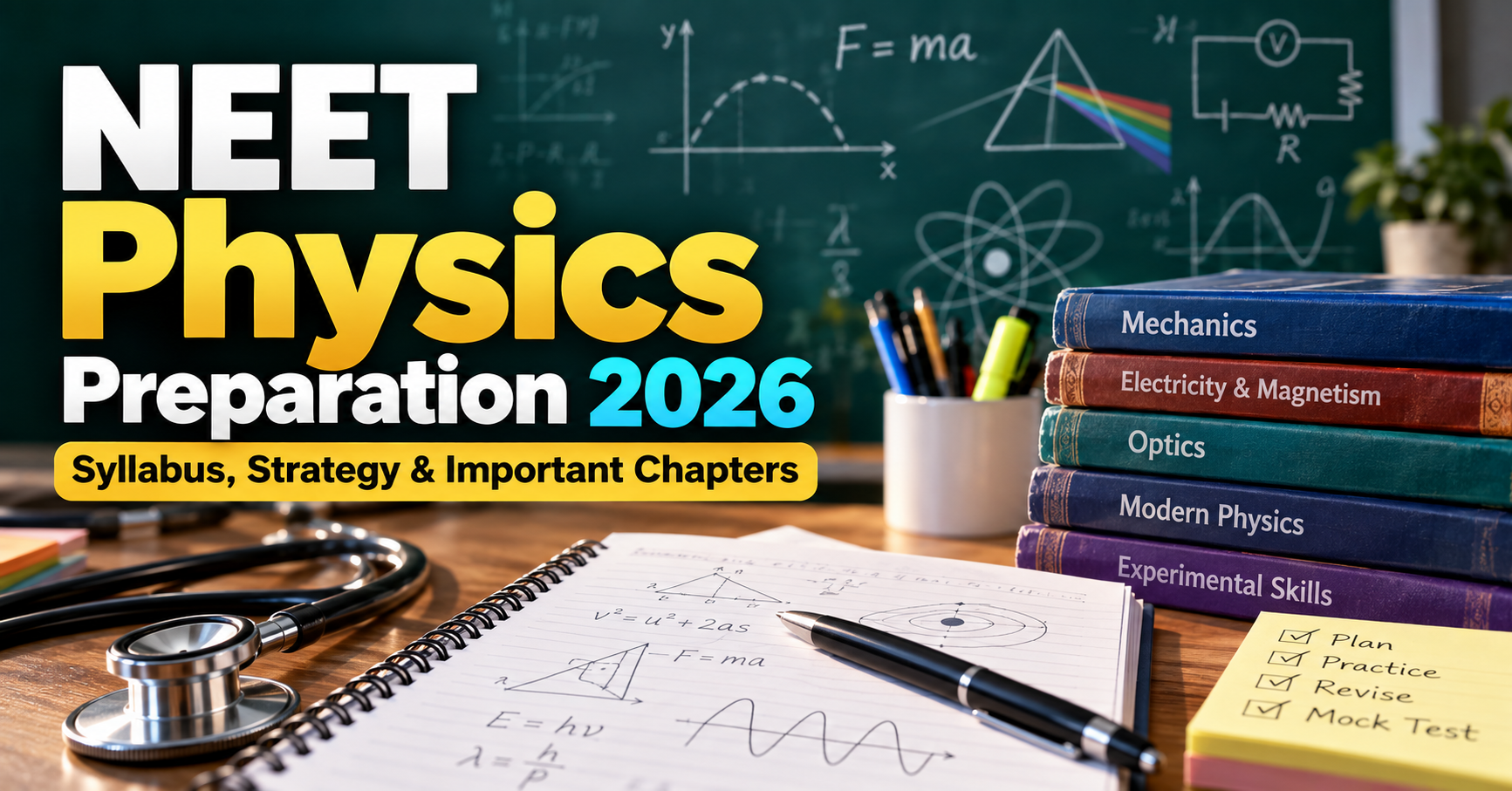
Preparing for NEET Physics can feel challenging because the subject requires more than memorising formulas. Students need to understand concepts, apply equations correctly, interpret graphs and solve numerical problems within a limited time.
For NEET UG 2026, Physics has 45 questions carrying 180 marks. The complete NEET paper contains 180 compulsory questions for 720 marks and is conducted for three hours. Each correct answer carries 4 marks, while an incorrect answer results in a 1-mark deduction.
This makes Physics an important part of a well-balanced NEET preparation strategy.
NEET Physics Syllabus 2026
The National Medical Commission (NMC) finalized the NEET UG 2026 syllabus in December 2025. The official Physics syllabus contains 20 units, ranging from Physics and Measurement to Experimental Skills.
The major units are:
- Physics and Measurement
- Kinematics
- Laws of Motion
- Work, Energy and Power
- Rotational Motion
- Gravitation
- Properties of Solids and Liquids
- Thermodynamics
- Kinetic Theory of Gases
- Oscillations and Waves
- Electrostatics
- Current Electricity
- Magnetic Effects of Current and Magnetism
- Electromagnetic Induction and Alternating Currents
- Electromagnetic Waves
- Optics
- Dual Nature of Matter and Radiation
- Atoms and Nuclei
- Electronic Devices
- Experimental Skills
Students should always refer to the latest NTA/NMC syllabus instead of relying solely on older chapter lists because the official syllabus can be updated. The NMC specifically advised NEET UG 2026 aspirants and stakeholders to use the updated syllabus for preparation.
How Many Marks Does Physics Carry in NEET 2026?
| Subject | Questions | Marks |
|---|---|---|
| Physics | 45 | 180 |
| Chemistry | 45 | 180 |
| Biology | 90 | 360 |
| Total | 180 | 720 |
Physics therefore contributes 25% of the total NEET marks.
The 2026 examination uses four-option MCQs with one correct/best answer. The marking scheme is +4 for a correct answer, -1 for an incorrect answer and 0 for an unanswered question.
Important Physics Chapters for NEET Preparation
Instead of preparing only a few chapters because they appear frequently in previous papers, students should cover the complete official syllabus. However, some areas deserve particular attention because they form the foundation for solving many numerical and conceptual questions.
1. Current Electricity
Focus on:
- Ohm’s law
- Resistance and resistivity
- Series and parallel combinations
- Kirchhoff’s laws
- Cells and internal resistance
- Wheatstone bridge
- Metre bridge
- Electrical power
The official 2026 syllabus explicitly includes these topics under Current Electricity.
2. Electrostatics
Important areas include:
- Coulomb’s law
- Electric field
- Electric potential
- Electric dipole
- Gauss’s law
- Capacitors
- Combination of capacitors
- Energy stored in a capacitor
These concepts frequently require students to combine formulas with physical understanding.
3. Optics
Give adequate time to:
- Mirrors
- Lenses
- Refraction
- Total internal reflection
- Lens maker’s formula
- Optical instruments
- Young’s double-slit experiment
- Diffraction
- Polarisation
Optics is one of the broader sections of the official syllabus and includes both ray and wave optics.
4. Modern Physics
Modern Physics includes:
- Photoelectric effect
- Dual nature of matter
- de Broglie relation
- Atomic models
- Bohr model
- Hydrogen spectrum
- Nuclear physics
- Mass defect
- Binding energy
- Fission and fusion
- Semiconductor devices
- Logic gates
The NMC’s 2026 syllabus includes these topics across Units 17–19.
5. Mechanics
Build a strong foundation in:
- Kinematics
- Newton’s laws
- Friction
- Work, energy and power
- Circular motion
- Centre of mass
- Rotational motion
- Gravitation
These chapters develop the problem-solving skills needed for many Physics questions.
How to Prepare Physics for NEET 2026
Step 1: Start With the Official Syllabus
Download the current syllabus and divide it into manageable study blocks. Don’t prepare from an old chapter list without checking it against the latest NMC syllabus.
Step 2: Build Concepts Before Memorising Formulas
A formula is useful only when you understand when to apply it.
For every important equation, ask:
What does it represent? What are its units? When can I use it? What happens if one variable changes?
This approach makes unfamiliar numerical questions easier to handle.
Step 3: Maintain a Formula and Mistake Notebook
Create two separate sections:
Formula Sheet
- Important equations
- Units
- Relationships between quantities
- Short concept reminders
Mistake Log
- Incorrect calculations
- Conceptual mistakes
- Formula-selection mistakes
- Questions misunderstood because of wording
Review the mistake log regularly instead of simply solving more questions.
Step 4: Solve Questions After Every Topic
Don’t wait until the entire syllabus is finished.
After completing a chapter:
- Revise the concept.
- Review formulas.
- Solve basic questions.
- Attempt mixed numerical problems.
- Analyse mistakes.
- Revisit weak concepts.
This creates a feedback loop between learning and testing.
Step 5: Practise Under Time Pressure
NEET UG 2026 has 180 compulsory questions to be attempted in 180 minutes.
Students should therefore practise timed Physics sections rather than solving every question without a clock.
The objective is not simply to solve difficult questions. It is to identify the method quickly, calculate accurately and avoid unnecessary time consumption.
A Practical NEET Physics Study Plan
A simple weekly structure can look like this:
| Day | Focus |
|---|---|
| Monday | New concept + examples |
| Tuesday | Concept revision + basic questions |
| Wednesday | Numerical practice |
| Thursday | New concept + previous questions |
| Friday | Mixed practice |
| Saturday | Timed Physics test |
| Sunday | Test analysis + revision |
Students can adjust this schedule according to their school timetable and preparation level.
How to Improve Physics Accuracy
Accuracy becomes particularly important because NEET uses negative marking.
Use these habits:
- Read the complete question before calculating.
- Check units before selecting an answer.
- Draw a diagram where appropriate.
- Estimate the answer before doing lengthy calculations.
- Don’t blindly substitute values into formulas.
- Recheck signs in vector/electrical problems.
- Avoid guessing when you cannot eliminate options confidently.
- Analyse every mistake after a test.
What About Experimental Skills?
Experimental Skills should not be ignored.
The official 2026 syllabus includes practical familiarity with experiments involving Vernier calipers, screw gauge, simple pendulum, Young’s modulus, surface tension, viscosity, resonance tube, specific heat, metre bridge, Ohm’s law, galvanometer, mirrors, lenses, prism and semiconductor devices.
Students should therefore review the basic principle, apparatus, measurements and observations associated with the listed experiments.
Common Mistakes Students Make in NEET Physics
Studying Only Formulas
Knowing formulas without understanding their conditions of application can lead to mistakes.
Ignoring Units
Units can help identify calculation errors and sometimes eliminate incorrect options.
Avoiding Difficult Chapters
Leaving large portions of the syllabus untouched can reduce the number of questions you are prepared to attempt.
Solving Without Analysis
A test is useful only when you understand why you made mistakes.
Using Too Many Study Sources
Switching repeatedly between books, lectures and question banks can make revision inefficient. Choose a manageable set of resources and use them consistently.
How to Revise Physics Before NEET
During the final revision phase, focus on:
- Formula revision
- Important concepts
- Previous mistakes
- Timed question practice
- Mock-test analysis
- Weak chapters
- Units and dimensions
- Graph-based questions
- Experimental Skills
Don’t try to learn the entire syllabus from scratch during the final days. The final phase should primarily strengthen recall, accuracy and question-solving speed.
Frequently Asked Questions
How many Physics questions are there in NEET 2026?
NEET UG 2026 has 45 Physics questions carrying 180 marks.
How many marks is Physics worth in NEET?
Physics carries 180 marks out of the total 720 marks in NEET UG 2026.
Is there negative marking in NEET Physics?
Yes. A correct answer receives +4 marks, an incorrect answer receives -1 mark, and an unanswered question receives 0 marks.
How many Physics units are in the NEET 2026 syllabus?
The official NMC Physics syllabus for NEET UG 2026 contains 20 units, including Experimental Skills.
Which Physics chapters should I study first for NEET?
Start with foundational areas such as Kinematics, Laws of Motion, Work Energy and Power and basic electricity, then progressively cover the remaining syllabus. Don’t permanently skip chapters based only on perceived importance.
Final Takeaway
A strong NEET Physics preparation strategy is built around complete syllabus coverage, conceptual clarity, regular numerical practice and careful test analysis.
For NEET UG 2026, students should work from the official NMC syllabus and remember that Physics contributes 45 questions and 180 marks to the examination.
Instead of asking only, “Which chapters are important?”, a better question is:
“How well can I understand, apply and revise every chapter in the syllabus?”
With consistent practice and a structured revision plan, Physics preparation becomes much more manageable.